Skip to content

Changelog_

Explore Appwrite's changelog to stay on top of all the product updates and track our journey.

  1. Functions and Sites builds skip npm audit by default for faster deploys

    Appwrite Functions and Appwrite Sites now disable npm's security audit step during dependency installation by default. npm runs this check automatically on install, even though it is not required to resolve or download packages. When npm's advisory service is slow or unavailable, builds can stall for several minutes while the same install finishes in seconds under normal conditions.

    Turning audit off by default makes builds faster and more predictable, shortens iteration loops, and reduces build compute on Appwrite Cloud. The change applies to Appwrite Cloud and self-hosted deployments running updated runtimes. Builds that use Bun, pnpm, or Yarn are unchanged.

    If you still want dependency auditing during builds, set the environment variable npm_config_audit to true on your function or site and redeploy. npm will run its advisory checks again on install. You can also add npm audit to your install or build commands for a one-off check without changing the default for every deployment.
  2. Buy domains and host DNS inside your Appwrite organization

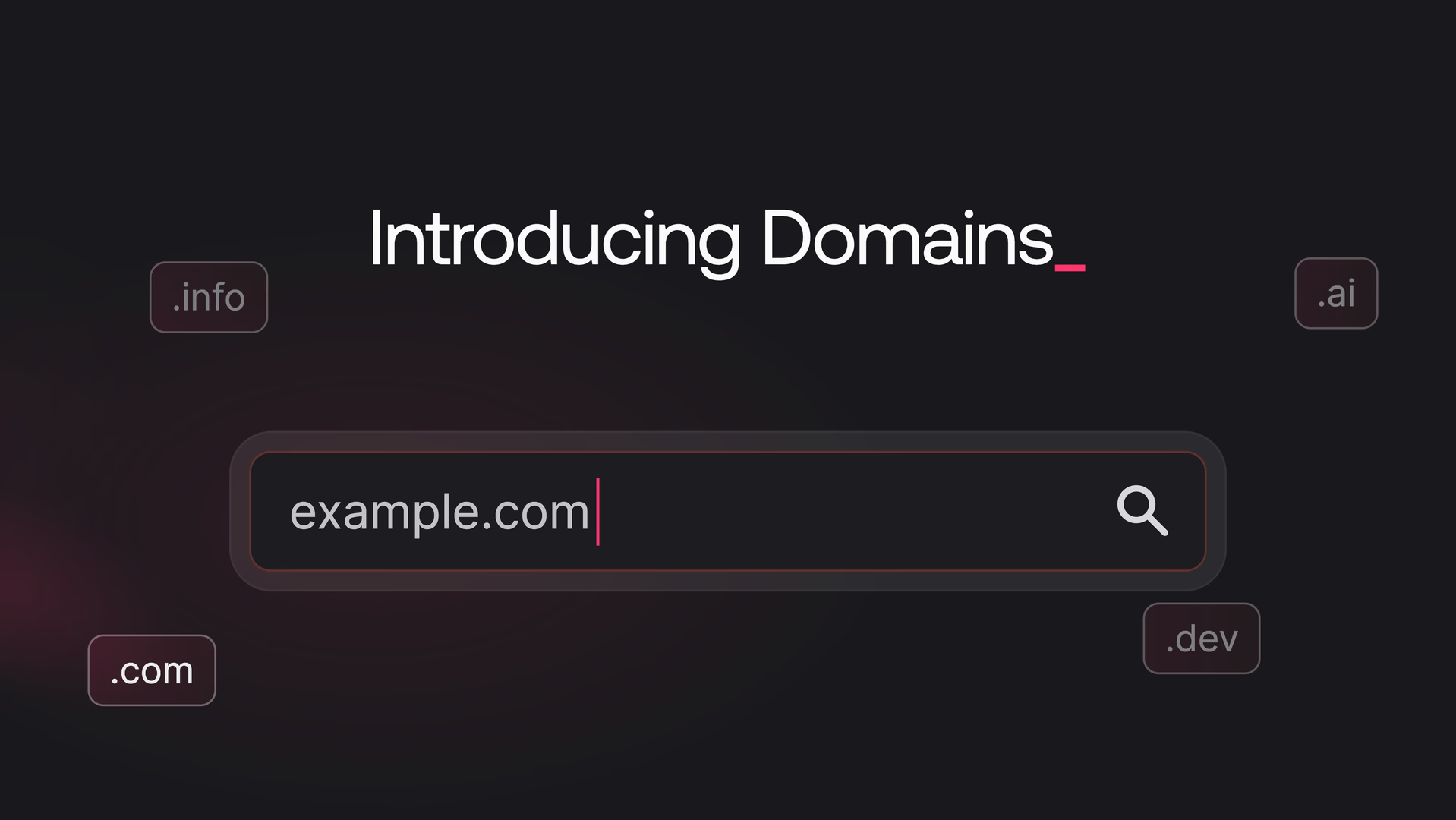
    Appwrite Domains is now available on Appwrite Cloud. Open Organization > Domains to register a name across more than 160 TLDs, transfer an existing registration in, or add a domain you keep registered elsewhere by pointing its nameservers at ns1.appwrite.zone and ns2.appwrite.zone.

    Verified domains get an authoritative DNS zone you edit in the Console, with A, AAAA, CNAME, MX, TXT, NS, SRV, CAA, HTTPS, and ALIAS records, BIND zone file import and export, and one-click MX presets for Google Workspace, Outlook, Mailgun, Zoho, ProtonMail, and iCloud. Records that carry routing and TLS renewal are locked so they cannot be edited away.

    Attach hostnames to Sites, Functions, and custom API endpoints from the same zone, and Appwrite issues and renews the certificates. Auto-renewal, registrar transfer out, and moving a domain to another organization you own all live on the domain Settings tab.

  3. Deploy Appwrite Sites and Functions from Bitbucket

    Bitbucket joins GitHub and GitLab as a Git provider for Appwrite Sites and Functions. Connect it from Project settings > Git configuration, or from the empty state in the Site and Function creation wizards.

    Every Bitbucket workspace your account can reach appears as a selectable owner in the repository picker, alongside owners from any other provider connected to the project. Pushes to your production branch build and activate, and other branches build into a preview link for review.

    Commit, branch, and pull request links resolve to Bitbucket's own URL shapes rather than GitHub's, and repositories are recognized by their URL as well as their recorded provider, so connections made before this release resolve correctly too.

    Every commit also receives a commit status on Bitbucket, green when the Appwrite build succeeds and red when it fails, so a pull request shows deployment health without leaving Bitbucket. Appwrite comments on the pull request as well, listing every preview the push triggered across your Sites, Functions, and projects, with the deployment status, a link to the build logs, the preview URL, and a QR code that opens the preview on a phone.

  4. Deploy Appwrite Sites and Functions from GitLab

    GitLab is now a Git provider for Appwrite Sites and Functions. Connect a GitLab account from Project settings > Git configuration, or from the empty state in the Site and Function creation wizards, and deploy straight from your GitLab repositories.

    One connection covers your personal namespace and every group you belong to. Each namespace appears as its own owner in the repository picker, next to any GitHub organizations you have connected, so selecting a group takes no more clicks than selecting an organization. New repositories can be created directly inside the group you choose.

    Pushes behave as they always have. Your production branch builds and activates, and other branches build into a preview link that only members of your Appwrite organization can open. Commit, branch, and merge request links resolve to GitLab's own URL shapes.

    Every commit also receives a commit status on GitLab, green when the Appwrite build succeeds and red when it fails, so a merge request shows deployment health without leaving GitLab. Appwrite comments on the merge request as well, listing every preview the push triggered across your Sites, Functions, and projects, with the deployment status, a link to the build logs, the preview URL, and a QR code that opens the preview on a phone.

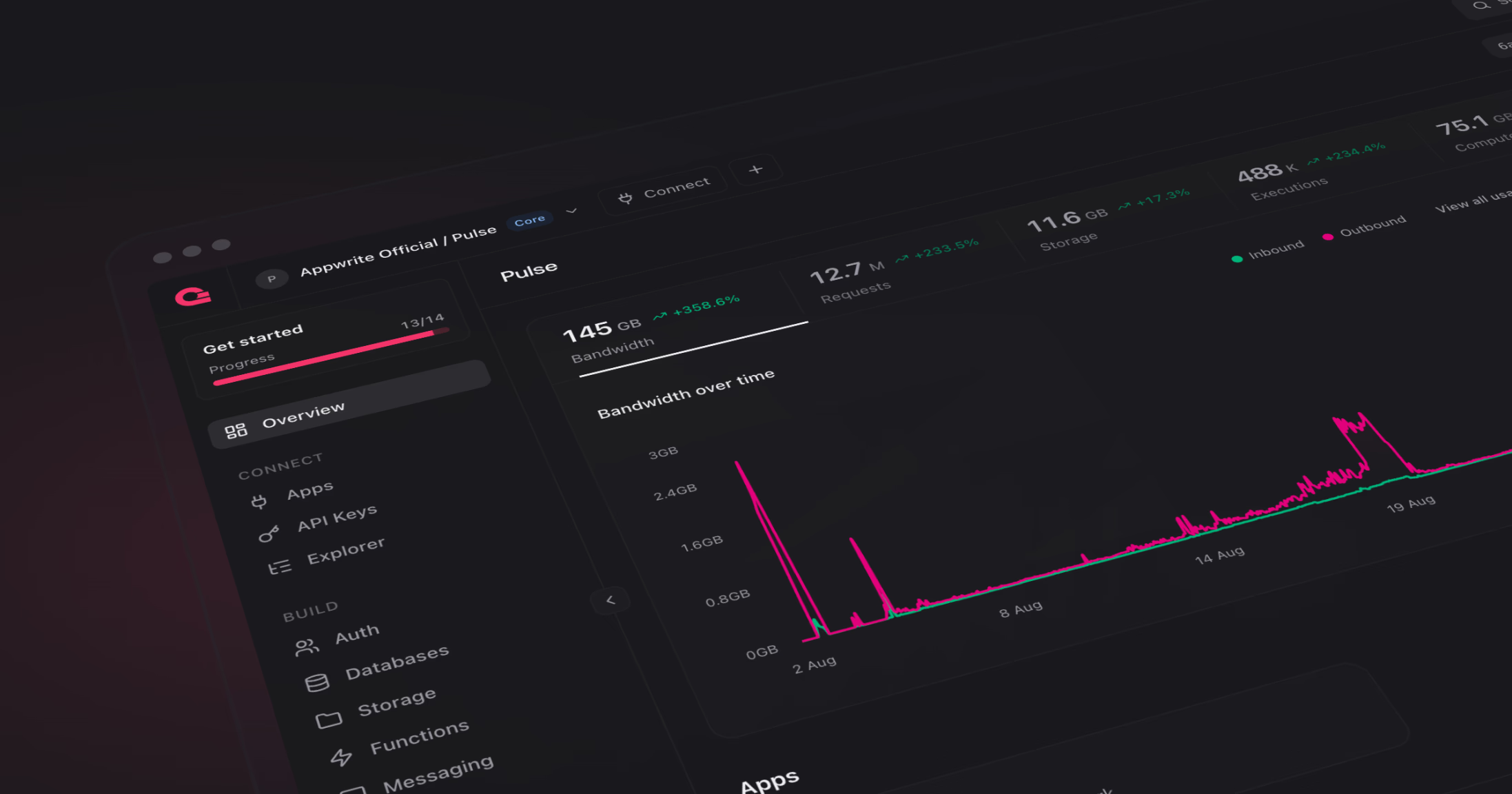
  5. Console IV brings appwrite.io and the Console into one app

    Console IV is the fourth generation of the Appwrite Console, rebuilt on TanStack Start with React, Tailwind CSS, and ShadCN UI. It replaces the two codebases behind appwrite.io and the old Console, so the marketing pages, documentation, blog, changelog, and every project route now run in one application.

    Docs links inside the Console open a resizable pane next to the page you are on, with their own breadcrumb and back navigation, so you can read the guide without losing the form you were filling in. The Command Center works across account, organization, project, and docs scopes, and Search documentation is available in all four.

    Console URLs changed shape. The /console prefix is gone, and the region and typed-resource segments went with it, so /console/project-fra-68a1c2/auth/user-9f3d0b is now /projects/68a1c2/auth/users/9f3d0b. Old links redirect to their new equivalents. Your API keys, SDK code, and the way your applications call Appwrite are unaffected.

Ready to build?_